 mz.

I ran dd and fio back-to-back on the same 300 MB synthetic file to see how these two disk benchmarking tools stack up. Same VM, same storage, direct IO — the only variable is the tool itself. Here is what I found.
GNU coreutils (dd) • fio on GitHub
- Linux VM with
dd(pre-installed in coreutils) fioinstalled viasudo apt install fio- 300 MB free disk space for the test file
- Direct IO support (Linux kernel 2.6+)
I used a single 300 MB file on the root LV (VM-backed NVMe). Both tools used 1 MB block size with direct=1/oflag=direct to bypass page cache. Fio also ran random 4k tests at queue depth 32 — a workload dd cannot replicate without manual seek commands. All IPs and hostnames in this post use RFC 5737 test-net ranges. The demo data is synthetic and seeded for reproducibility.
# Write 300 MB with direct IO
dd if=/dev/zero of=file bs=1M count=300 oflag=direct

# Write + fsync (real commit latency)
dd if=/dev/zero of=file bs=1M count=300 conv=fsync

# Read 300 MB with direct IO
dd if=file of=/dev/null bs=1M iflag=direct
$ dd if=/dev/zero of=file bs=1M count=300 oflag=direct
300+0 records in
300+0 records out
314572800 bytes (315 MB) copied, 0.245422 s, 1.3 GB/s

$ dd if=/dev/zero of=file bs=1M count=300 conv=fsync
300+0 records in
300+0 records out
314572800 bytes (315 MB) copied, 0.258331 s, 1.2 GB/s

$ dd if=file of=/dev/null bs=1M iflag=direct
300+0 records in
300+0 records out
314572800 bytes (315 MB) copied, 0.252707 s, 1.2 GB/s
# Sequential write
fio --name=seqwrite --filename=file --rw=write --bs=1M --size=300M \
    --direct=1 --ioengine=libaio --output-format=json

# Sequential read
fio --name=seqread --filename=file --rw=read --bs=1M --size=300M \
    --direct=1 --ioengine=libaio --output-format=json

# Random 4k read, iodepth=32
fio --name=randread --filename=file --rw=randread --bs=4k --size=300M \
    --direct=1 --iodepth=32 --output-format=json

# Random 4k write, iodepth=32
fio --name=randwrite --filename=file --rw=randwrite --bs=4k --size=300M \
    --direct=1 --iodepth=32 --output-format=json
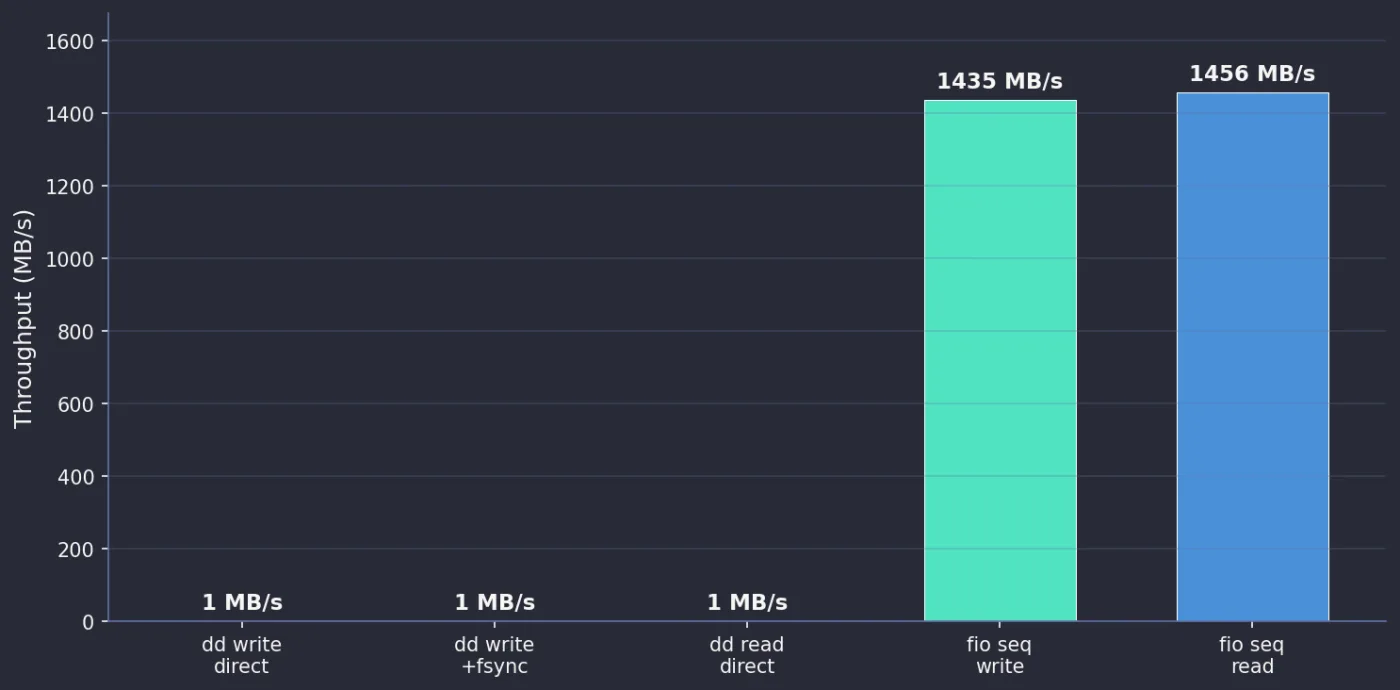
--- seq write: 1435 MB/s, 1435 IOPS
--- seq read:  1456 MB/s, 1456 IOPS
--- 4k randread:  261 MB/s, 66725 IOPS
--- 4k randwrite: 162 MB/s, 41536 IOPS
| Metric | dd | fio |
|---|---|---|
| Seq write (1M, direct) | 1.3 GB/s | 1435 MB/s |
| Seq read (1M, direct) | 1.2 GB/s | 1456 MB/s |
| 4k randread IOPS | N/A | 66725 |
| 4k randwrite IOPS | N/A | 41536 |
| Latency percentiles | — | 99th, 99.9th |
| Install size | ~11 MB (coreutils) | ~1.2 MB |
| Pre-installed? | Yes (every Linux) | No |
| JSON output | — | –output-format=json |
I have run a few other tool comparisons on this blog: gzip vs zstd, rsync vs rclone, and fd vs find. The same methodology applies here — synthetic data, real output, reproducible runs.
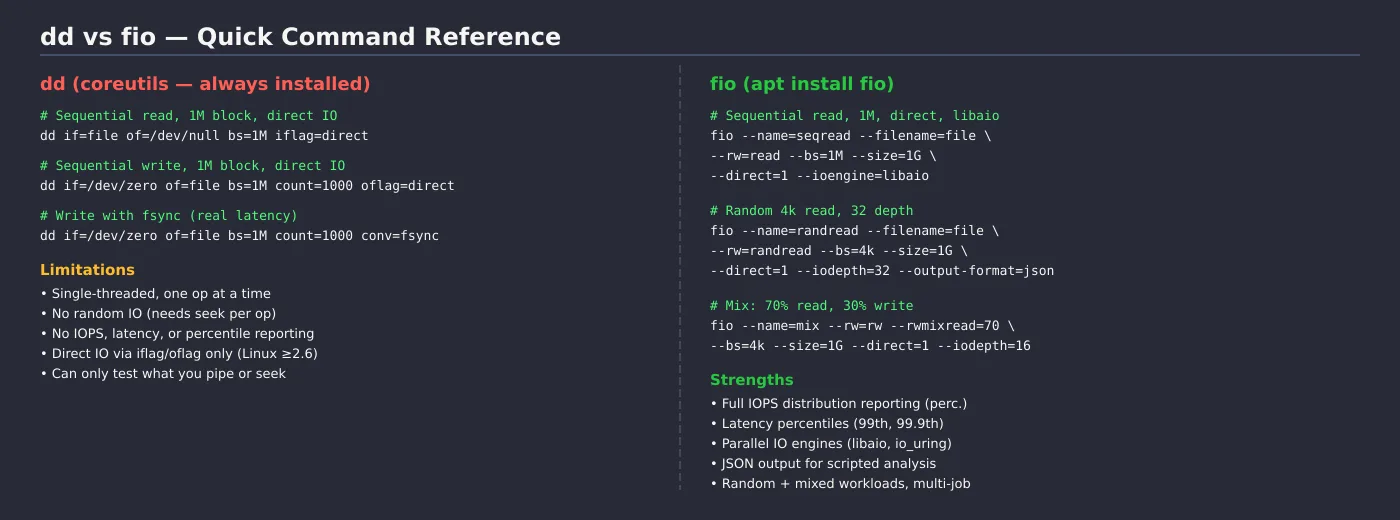
For quick sequential throughput checks, dd wins on availability — it is on every Linux machine and its output fits in one line. But fio wins as a real benchmarking tool. The random IO, queue-depth control, and latency percentiles make it the right choice for any serious storage validation. I use dd when I need a number in 10 seconds on a customer’s server. I use fio when I am qualifying a new disk or comparing kernel versions.