 mz.

I rebuilt a staging box from an old notes file last month and only found out afterwards how much had quietly changed. Since then I capture the installed package list on every server before touching it, and a short Python script diffs the two lists in one pass.
The idea is simple: dpkg-query gives you a tab-separated name/arch/version list on any Debian or Ubuntu machine, and the script does set math on package names plus a version string comparison. It reports three things – packages missing on the new box, packages the new box gained, and packages where the version drifted. Exit code is 0 when clean and 1 when there is drift, so it drops straight into cron. If you want a broader look at what each package does security-wise, I covered patching the gaps with OSV.dev earlier.
Reference material: dpkg-query manpage and OSV.dev for the CVE follow-up.
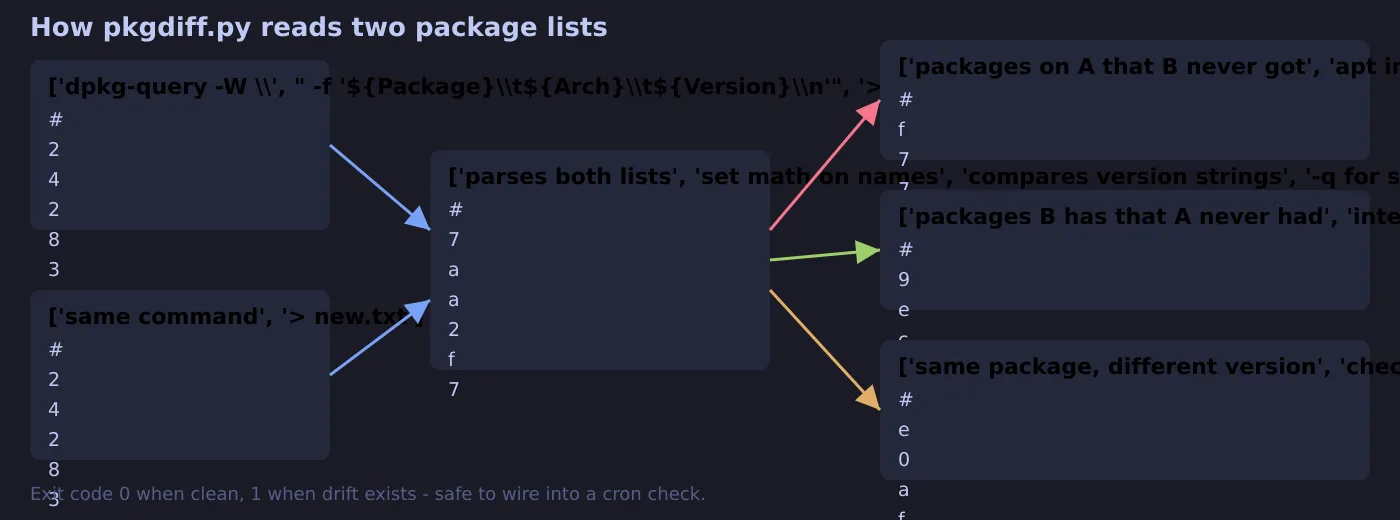
Capture the package list on each server
On each server, as root or your own user (dpkg-query needs no elevated rights to read the status database):
dpkg-query -W -f='${Package}\t${Architecture}\t${Version}\n' | awk -F'\t' '$3 != ""' | sort > new-server.txtThe script
This is the exact file that ran in my sandbox, no cleverness in it: plain dicts, sorted set differences, and one guard against the broken lines dpkg emits for meta-packages. The demo lists below are synthetic, a hand-edited copy of a real capture from an Ubuntu 26.04 box, so nobody is confused about which server is which.
#!/usr/bin/env python3
"""pkgdiff.py - compare two dpkg package lists and report the drift."""
import argparse
import sys
from pathlib import Path

def load_list(path):
    """Parse a tab-separated 'namearchversion' list from dpkg-query."""
    pkgs = {}
    for lineno, line in enumerate(path.read_text().splitlines(), 1):
        line = line.strip()
        if not line or line.startswith("#"):
            continue
        parts = line.split("\t")
        if len(parts) != 3 or not parts[2]:
            sys.exit(f"{path}:{lineno}: bad line (need name/arch/version, tab-separated): {line!r}")
        pkgs[parts[0]] = {"arch": parts[1], "ver": parts[2]}
    return pkgs

def main():
    ap = argparse.ArgumentParser(description="Diff two dpkg -W package lists.")
    ap.add_argument("list_a", type=Path, help="reference list (e.g. the server you are leaving)")
    ap.add_argument("list_b", type=Path, help="target list (e.g. the rebuild you are checking)")
    ap.add_argument("--quiet", action="store_true", help="summary lines only")
    args = ap.parse_args()

    a, b = load_list(args.list_a), load_list(args.list_b)
    only_a = sorted(set(a) - set(b))
    only_b = sorted(set(b) - set(a))
    differ = sorted(n for n in set(a) & set(b) if a[n]["ver"] != b[n]["ver"])

    print(f"pkgdiff: {args.list_a.name} ({len(a)} pkgs) vs {args.list_b.name} ({len(b)} pkgs)")
    print(f"  only in {args.list_a.name}: {len(only_a)}")
    print(f"  only in {args.list_b.name}: {len(only_b)}")
    print(f"  version differs        : {len(differ)}")

    if args.quiet:
        return 0 if not (only_a or only_b or differ) else 1

    if only_a:
        print(f"\nMISSING on {args.list_b.name} (was on {args.list_a.name}):")
        for n in only_a:
            print(f"  - {n}\t{a[n]['ver']}")
    if only_b:
        print(f"\nNEW on {args.list_b.name} (not on {args.list_a.name}):")
        for n in only_b:
            print(f"  + {n}\t{b[n]['ver']}")
    if differ:
        print("\nVERSION DRIFT:")
        for n in differ:
            print(f"  ~ {n}\t{a[n]['ver']}  ->  {b[n]['ver']}")

    return 0 if not (only_a or only_b or differ) else 1

if __name__ == "__main__":
    sys.exit(main())
Run it
Two input files, one command. This is the real captured output, from the same sandbox session that ran the script above. The demo lists are synthetic: a real capture from an Ubuntu 26.04 box, hand-aged to look like the old staging server.
python3 pkgdiff.py old-server.txt new-server.txt
pkgdiff: old-server.txt (20 pkgs) vs new-server.txt (19 pkgs)
  only in old-server.txt: 2
  only in new-server.txt: 1
  version differs        : 7

MISSING on new-server.txt (was on old-server.txt):
  - apache2	1:2.4.66-1ubuntu4
  - python3-pip	25.1.1+dfsg-1ubuntu2

NEW on new-server.txt (not on old-server.txt):
  + nginx	1.28.3-2ubuntu1.14

VERSION DRIFT:
  ~ curl	8.12.1-1ubuntu2.4  ->  8.18.0-1ubuntu2.8
  ~ docker.io	28.3.0-0ubuntu2  ->  29.1.3-0ubuntu4.1
  ~ git	1:2.50.1-1ubuntu1  ->  1:2.53.0-1ubuntu1.1
  ~ linux-generic	6.14.0-36.36  ->  7.0.0-43.43
  ~ openssh-server	1:9.9p1-3ubuntu3.2  ->  1:10.2p1-2ubuntu3.8
  ~ openssl	3.4.1-1ubuntu4.5  ->  3.5.5-1ubuntu3.7
  ~ python3	3.13.7-1ubuntu2  ->  3.14.3-0ubuntu2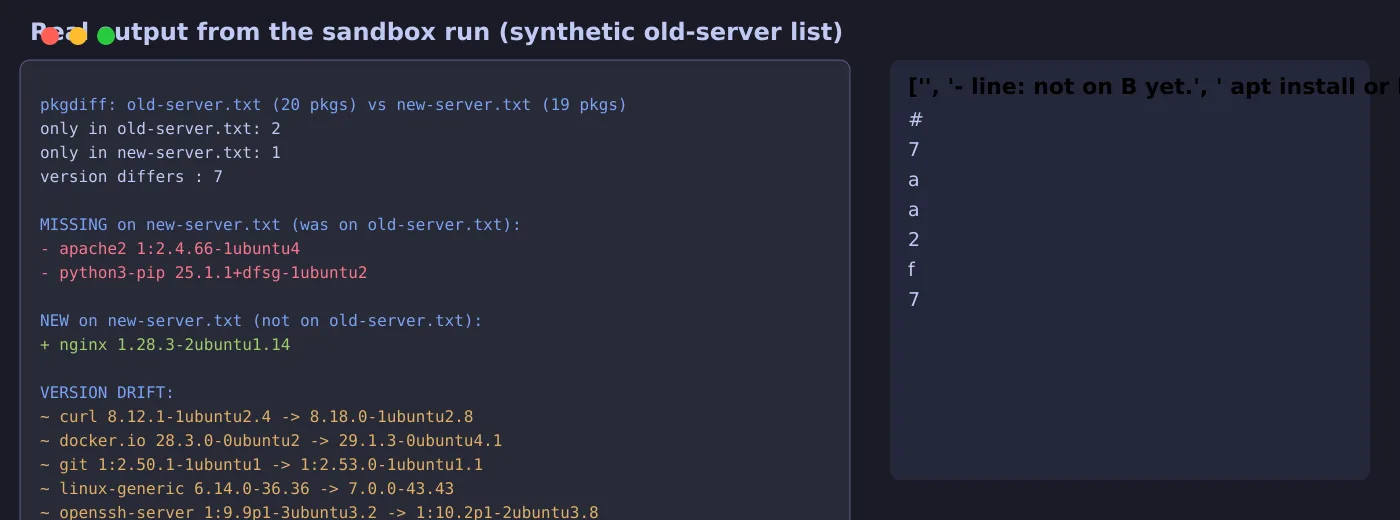
The MISSING block is the punchline of a migration audit: an old box running Apache became an nginx box, so apache2 falling off is expected, but python3-pip silently disappearing is the kind of thing that bites you two weeks later. It pairs well with the other CSV reconciliation and backup verification scripts on this blog – same idea, different inputs.
The crash that shaped the parser
A genuine catch from verification: my first capture piped dpkg-query -W nginx-core nginx on a box where nginx-core was not installed, and dpkg happily printed a line with an empty version field. The draft parser unpacked that line into a dict and died later on the version lookup. The len(parts) != 3 or not parts[2] guard now fails loudly with file and line number instead of a traceback 200 lines downstream:
python3 pkgdiff.py bad.txt new-server.txt
bad.txt:1: bad line (need name/arch/version, tab-separated): 'broken-meta\tall'Cron it
Store a known-good baseline, run the comparison against a fresh capture, and only act on a non-zero exit:
# nightly drift check, only alert when something moved
python3 /opt/scripts/pkgdiff.py /srv/pkglists/old-server.txt /srv/pkglists/new-server.txt -q || \
curl -fsS --data "drift detected on $(hostname)" https://api.example.net/notifyThree lists, one command, zero surprises left on the table between the old box and the new one.