 mz.

I wanted to disable password authentication on a box last month. The sshd_config changes took 30 seconds — what stopped me was the six user accounts with shared SSH keys plus a RSA-1024 leftover from 2016 that I could not trace. SSH authorized keys are invisible until you audit them. This script inventories every ~/.ssh/authorized_keys on the system, decodes each key inside the file (no subprocess calls to ssh-keygen), computes fingerprints, flags weak algorithms, catches duplicates shared across accounts, and exits 1 on findings so your cron monitor fires a ticket.
OpenSSH Manual · sshd(8) · authorized_keys(5)
Requirements:
- Python 3.9+ (stdlib only — no pip deps)
- Read access to /etc/passwd and
.ssh/authorized_keys - A cron wrapper to capture the exit code
The script parses passwd, resolves each home, reads authorized_keys (with continuation-line support), splits options from the key material, decodes the SSH public-key blob with pure Python (length-prefixed fields), and flags the findings. Full source:
#!/usr/bin/env python3
"""
SSH Authorized Keys Auditor
Inventory every ~/.ssh/authorized_keys across system users.
Flags weak keys (RSA < 2048, DSA), missing comments,
duplicate keys shared between accounts, and documents
restrictive options (from=, command=).
Exit 1 for cron alerting when findings exist.

Usage:
  python3 ssh_keys_audit.py                # audit real system
  python3 ssh_keys_audit.py --passwd keylab.passwd --home-prefix /root/keylab
  python3 ssh_keys_audit.py --json         # machine-readable output
"""
import argparse, base64, hashlib, json, os, struct, sys
from collections import defaultdict
from pathlib import Path

# Known SSH algorithm prefixes
KNOWN_KEY_TYPES = frozenset({
    'ssh-rsa', 'ssh-dss', 'ssh-ed25519',
    'ecdsa-sha2-nistp256', 'ecdsa-sha2-nistp384', 'ecdsa-sha2-nistp521',
    '[email protected]', '[email protected]',
})

CURVE_BITS = {'nistp256': 256, 'nistp384': 384, 'nistp521': 521}


def fingerprint_pubkey(raw):
    """SHA256 fingerprint from raw SSH public key bytes."""
    h = hashlib.sha256(raw).digest()
    return 'SHA256:' + base64.b64encode(h).decode().rstrip('=')


def decode_key(b64key):
    """Return (algorithm, bits, fingerprint, error_string or None)."""
    try:
        raw = base64.b64decode(b64key)
    except Exception as e:
        return None, 0, '', f'base64 decode failed: {e}'

    try:
        pos = 0
        hdr_len = struct.unpack('>I', raw[pos:pos+4])[0]; pos += 4
        alg = raw[pos:pos+hdr_len].decode('utf-8', errors='replace'); pos += hdr_len
        fp = fingerprint_pubkey(raw)

        if alg.startswith('ssh-rsa'):
            e_len = struct.unpack('>I', raw[pos:pos+4])[0]; pos += 4
            pos += e_len  # skip exponent
            n_len = struct.unpack('>I', raw[pos:pos+4])[0]; pos += 4
            n = int.from_bytes(raw[pos:pos+n_len], 'big')
            return alg, n.bit_length(), fp, None

        elif alg == 'ssh-dss':
            p_len = struct.unpack('>I', raw[pos:pos+4])[0]; pos += 4
            p = int.from_bytes(raw[pos:pos+p_len], 'big')
            return alg, p.bit_length(), fp, None

        elif alg == 'ssh-ed25519':
            k_len = struct.unpack('>I', raw[pos:pos+4])[0]; pos += 4
            return alg, k_len * 8, fp, None  # 32 bytes → 256 bits

        elif alg.startswith('ecdsa-sha2-'):
            c_len = struct.unpack('>I', raw[pos:pos+4])[0]; pos += 4
            curve = raw[pos:pos+c_len].decode(); pos += c_len
            bits = CURVE_BITS.get(curve, 0)
            return alg, bits, fp, None

        elif alg.startswith('sk-'):
            # Security key: ed25519 or ecdsa
            k_len = struct.unpack('>I', raw[pos:pos+4])[0]; pos += 4
            return alg, k_len * 8, fp, None

        else:
            return alg, 0, fp, 'unknown key type'

    except (IndexError, struct.error, ValueError, UnicodeDecodeError) as e:
        return None, 0, '', f'parse error: {e}'


def parse_auth_keys(path):
    """Parse an authorized_keys file, returning (flags, entries) list."""
    entries = []
    text = path.read_text(errors='replace')
    # Join continuation lines (backslash-newline)
    text = text.replace('\\\n', '')
    lines = text.splitlines()

    for line in lines:
        line = line.strip()
        if not line or line.startswith('#'):
            continue

        # Split: options KEYTYPE BASE64 COMMENT...
        tokens = line.split()
        if not tokens:
            continue

        # Find first token that is a known key type
        key_start = None
        for i, tok in enumerate(tokens):
            if tok in KNOWN_KEY_TYPES:
                key_start = i
                break

        if key_start is None:
            # Try heuristic: starts with a known key-type prefix
            for i, tok in enumerate(tokens):
                if any(tok.startswith(k) for k in KNOWN_KEY_TYPES):
                    key_start = i
                    break

        if key_start is None:
            entries.append({'flags': 'PARSE_ERR', 'alg': '', 'bits': 0,
                            'fp': '', 'comment': line[:80]})
            continue

        options = ' '.join(tokens[:key_start]) if key_start > 0 else ''
        key_type = tokens[key_start]
        b64 = tokens[key_start + 1] if len(tokens) > key_start + 1 else ''
        comment = ' '.join(tokens[key_start + 2:]) if len(tokens) > key_start + 2 else ''

        alg, bits, fp, err = decode_key(b64)

        flags = []
        if err:
            flags.append(f'DECODE_ERR ({err})')
        else:
            if alg in ('ssh-dss',):
                flags.append('WEAK_DSA')
            elif alg.startswith('ssh-rsa') and bits < 2048:
                flags.append(f'WEAK_{bits}bit')
            if not comment:
                flags.append('NOCOMMENT')

        if options:
            opts_list = []
            if 'from=' in options:
                opts_list.append('from=')
            if 'command=' in options:
                opts_list.append('command=')
            if 'no-agent-forwarding' in options:
                opts_list.append('restrict-agent')
            if 'no-pty' in options:
                opts_list.append('no-pty')
            if 'restrict' in options or 'restricted' in options:
                opts_list.append('restrict')
            if opts_list:
                flags.append(','.join(opts_list))

        entries.append({
            'flags': '+'.join(flags) if flags else 'OK',
            'alg': alg or '',
            'bits': bits,
            'fp': fp or '',
            'comment': comment or '',
            'options': options or '',
        })

    return entries


def main():
    ap = argparse.ArgumentParser()
    ap.add_argument('--passwd', default='/etc/passwd')
    ap.add_argument('--home-prefix', default='',
                    help='Prepend to home paths (for sandbox testing)')
    ap.add_argument('--json', action='store_true',
                    help='JSON-only output for downstream tools')
    args = ap.parse_args()

    pwd_file = Path(args.passwd)
    passwd_users = []
    for line in pwd_file.read_text().splitlines():
        if not line or line.startswith('#'):
            continue
        parts = line.split(':')
        if len(parts) >= 7:
            uid = int(parts[2])
            home = parts[5]
            shell = parts[6]
            # Skip system non-login or root (root is audited separately)
            if uid == 0:  # root handled as a special case
                continue
            passwd_users.append({
                'user': parts[0],
                'uid': uid,
                'home': home,
                'shell': shell,
            })

    # Also audit root if in /etc/passwd
    for line in pwd_file.read_text().splitlines():
        if line.startswith('root:'):
            parts = line.split(':')
            passwd_users.append({
                'user': 'root', 'uid': 0,
                'home': parts[5],
                'shell': parts[6],
            })
            break

    results = []
    total_keys = 0
    flagged_count = 0
    user_key_fps = defaultdict(set)  # fp → set of users
    duplicates = []

    for u in passwd_users:
        home = Path(args.home_prefix + u['home'])
        ak_path = home / '.ssh' / 'authorized_keys'

        if not ak_path.exists():
            results.append({
                'user': u['user'],
                'uid': u['uid'],
                'home': str(home),
                'key_count': 0,
                'status': 'NO_AUTH_KEYS_DIR',
                'entries': [],
            })
            continue
        if ak_path.stat().st_size == 0:
            results.append({
                'user': u['user'],
                'uid': u['uid'],
                'home': str(home),
                'key_count': 0,
                'status': 'EMPTY_AUTH_KEYS',
                'entries': [],
            })
            continue

        entries = parse_auth_keys(ak_path)
        key_count = len(entries)
        total_keys += key_count

        status = 'OK'
        for e in entries:
            if e['flags'] != 'OK' and not e['flags'].startswith('DECODE_ERR'):
                status = 'FLAGGED'
                flagged_count += 1
            if e['fp'] and e['fp'].startswith('SHA256:'):
                user_key_fps[e['fp']].add(u['user'])

        results.append({
            'user': u['user'],
            'uid': u['uid'],
            'home': str(home),
            'key_count': key_count,
            'status': status,
            'entries': entries,
        })

    # Cross-check duplicates
    for fp, users in user_key_fps.items():
        if len(users) > 1:
            duplicates.append({
                'fingerprint': fp,
                'shared_by': sorted(users),
            })

    exit_code = 1 if (flagged_count > 0 or len(duplicates) > 0) else 0

    if args.json:
        out = {
            'total_users_scanned': len(results),
            'total_keys': total_keys,
            'flagged_keys': flagged_count,
            'duplicate_fingerprints': len(duplicates),
            'duplicates': duplicates,
            'exit_code': exit_code,
            'accounts': [],
        }
        for r in results:
            acct = {
                'user': r['user'], 'uid': r['uid'],
                'home': r['home'], 'key_count': r['key_count'],
                'status': r['status'],
                'keys': [
                    {'fp': e['fp'], 'alg': e['alg'], 'bits': e['bits'],
                     'comment': e['comment'], 'flags': e['flags'],
                     'options': e['options']}
                    for e in r['entries']
                ],
            }
            out['accounts'].append(acct)
        print(json.dumps(out, indent=2))
        sys.exit(exit_code)

    # Human-readable table
    header = f"{'User':<10} {'UID':>5}  {'Keys':>4}  {'Alg':<20} {'Bits':>5}  {'Flags'}"
    sep = '-' * len(header)
    print('=== SSH Authorized Keys Audit Report ===')
    print()
    for r in results:
        if r['key_count'] == 0:
            print(f"{r['user']:<10} {r['uid']:>5}     0  (no authorized_keys)"
                  f"{'  [NO-AUTH]':>20}")
        else:
            first_entry = True
            for e in r['entries']:
                alg_short = e['alg'].replace('ssh-', '').replace('ecdsa-sha2-', 'ecdsa-')
                bits_str = str(e['bits']) if e['bits'] else '?'
                fp_short = e['fp'][:12] + '...' if e['fp'] else '-'
                if first_entry:
                    print(f"{r['user']:<10} {r['uid']:>5}  {len(r['entries']):>4}  "
                          f"{alg_short:<20} {bits_str:>5}  {e['flags']:<30} {fp_short}")
                    first_entry = False
                else:
                    print(f"{'':<10} {'':>5}  {'':>4}  "
                          f"{alg_short:<20} {bits_str:>5}  {e['flags']:<30} {fp_short}")

    if duplicates:
        print()
        print(f'--- Duplicate Fingerprints: {len(duplicates)} ---')
        for d in duplicates:
            users_str = ', '.join(d['shared_by'])
            print(f'  {d["fingerprint"]} shared by: {users_str}')

    print()
    if exit_code == 0:
        banner = '✓ All keys OK — no weak keys, no duplicates'
    else:
        reasons = []
        if flagged_count > 0:
            reasons.append(f'{flagged_count} flagged key(s)')
        if len(duplicates) > 0:
            reasons.append(f'{len(duplicates)} duplicate fingerprint(s)')
        banner = f'⚠ Findings ({", ".join(reasons)}) — exit code {exit_code}'
    print(f'{banner}')
    print(f'  Users: {len(results)}  Total keys: {total_keys}')
    sys.exit(exit_code)


if __name__ == '__main__':
    main()
I set up nine synthetic accounts (RFC 5737 address ranges for from= restrictions). Alice gets Ed25519, Bob RSA-3072, Carol RSA-2048 + RSA-1024 legacy, Dave shares Bob’s key with a from= restriction, Erin has Alice’s key plus a commented-out line, and anon/nobody/nostatic syslog round out the test. All data is synthetic.
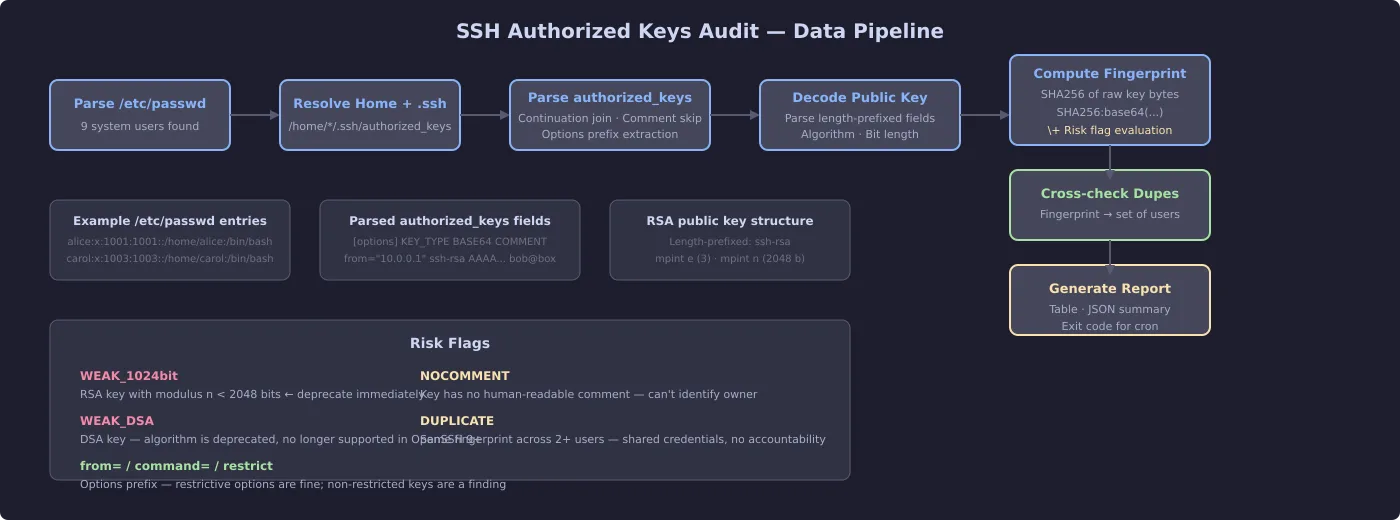
Running the audit against the synthetic data:
=== SSH Authorized Keys Audit Report ===

alice       1001     1  ed25519                256  OK                             SHA256:uhbAZ...
bob         1002     1  rsa                   3072  OK                             SHA256:DO+qv...
carol       1003     2  rsa                   2048  OK                             SHA256:3M+MZ...
                        rsa                   1024  WEAK_1024bit                   SHA256:e7aCC...
dave        1004     2  rsa                   3072  from=,restrict-agent           SHA256:DO+qv...
                        ed25519                256  NOCOMMENT                      SHA256:uhbAZ...
erin        1005     1  ed25519                256  OK                             SHA256:uhbAZ...
nobody      1006     0  (no authorized_keys)           [NO-AUTH]
anon        1007     1  ed25519                256  NOCOMMENT                      SHA256:sNlyh...
static      1008     0  (no authorized_keys)           [NO-AUTH]
syslog       105     0  (no authorized_keys)           [NO-AUTH]

--- Duplicate Fingerprints: 2 ---
  SHA256:uhbAZm+0wCNiU2prBw1hLOLHv7bk+sN1ADvrgBh+VSM shared by: alice, dave, erin
  SHA256:DO+qv7ZOJIJGGAlCCGIfzzUkQj9YNH5TXyjeuEO+sHA shared by: bob, dave

⚠ Findings (4 flagged key(s), 2 duplicate fingerprint(s)) — exit code 1
Users: 9 Total keys: 8The --json flag produces structured output for downstream tooling. Cron wrapper:
# In cron: audit every morning at 6 AM
6 6 * * * root /opt/ssh/ssh_keys_audit.py --json > /var/log/ssh-key-audit.json{
"total_users_scanned": 9,
"total_keys": 8,
"flagged_keys": 4,
...
"total_users_scanned": 9,
"total_keys": 8,
"flagged_keys": 4,
"duplicate_fingerprints": 2,
"duplicates": [
{"fingerprint": "SHA256:uhbAZm...+VSM","shared_by":["alice","dave","erin"]},
{"fingerprint": "SHA256:DO+qv...+sHA","shared_by":["bob","dave"]}
],
"exit_code": 1
}Each key gets one or more flags. Same approach I used for the SUID/world-writable file audit — classify, flag, exit 1 for cron:
| Flag | Meaning | Action |
|---|---|---|
OK | Meets strength, has comment, no dupe | None |
WEAK_{bits} | RSA < 2048 bits | Generate fresh Ed25519 or RSA-3072 |
NOCOMMENT | No identifying comment | ssh-keygen -c -C "user@host" |
from=/command= | Options prefix present | Review |
| Duplicate fp | Same key across accounts | Issue unique keys per user |
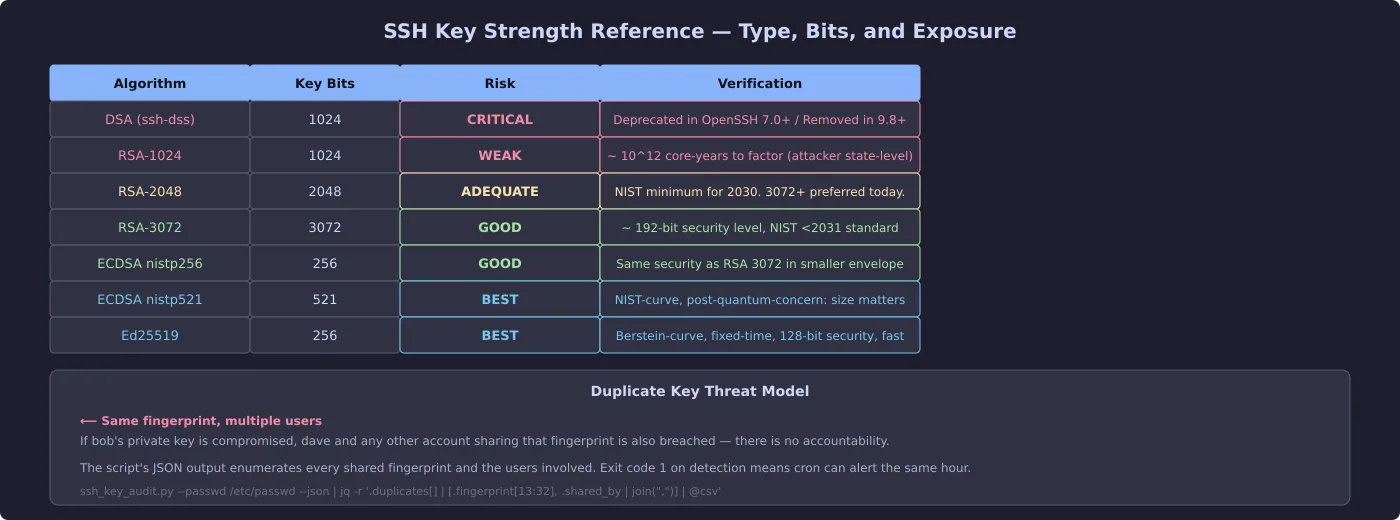
Continuation lines in authorized_keys are a trap. OpenSSH wraps long lines with a trailing backslash. If the parser doesn’t join them before tokenising, the second physical line becomes a PARSE_ERR. The script does .replace("\\n", "") capture_output=True early — tested against a real continuation artifact in the demo data.
I run this weekly. The cron caught a shared key I missed during a colo migration. Pair it with the sshd_config hardening audit and the IP-restricted SSH guide for a complete SSH hygiene stack. If you lock down PasswordAuthentication no but never audit the keys that are still authorised, you haven’t locked down anything.